How to Calculate the Percentage of Flat Roof on Your Home
You may be asked what percentage of your roof is flat when completing a home insurance quote. This guide explains how to estimate it accurately.
6
min read
When completing a home insurance quote, you may be asked whether any part of your roof is flat and, if so, what percentage of the total roof area it represents.
For many homes, especially those with extensions or integral garages, this can be surprisingly difficult to answer. Most properties are not entirely pitched or entirely flat, and you are not expected to provide an exact measurement.
This guide explains what insurers mean by a flat roof and how to estimate the percentage accurately and consistently.
What counts as a flat roof?
For insurance purposes, a flat roof usually means any section of roof that is not traditionally pitched and tiled or slated. Flat roofs often have a slight fall to allow water to drain, but they appear flat when viewed from ground level or above.
Common examples include:
Flat roofs over rear extensions
Flat roofs over kitchens or utility rooms
Flat roofs over integral garages
Roof terraces or balconies over living space
Flat roofs are commonly covered with materials such as felt, fibreglass (GRP) or rubber (EPDM), although the material itself is assessed separately from whether the roof is flat. Homes with mixed roof types are often treated as non-standard construction for insurance purposes.
What does the percentage refer to?
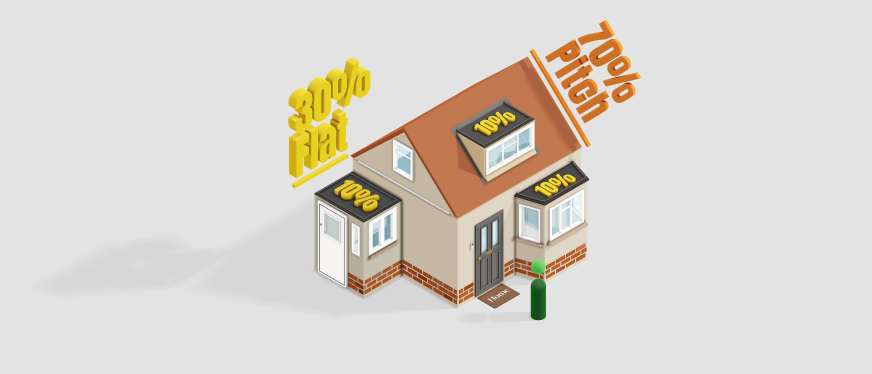
The percentage refers to the proportion of the entire roof area of the main building that is flat.
This includes:
The main house roof
Extensions
Porches
Conservatories
Integral garages
It does not include:
Detached garages
Sheds
Other outbuildings that do not form part of the main structure
The percentage is based on roof area, not the number of roof sections.
How to estimate the flat roof percentage
You do not need exact measurements. Insurers expect a reasonable estimate.
A simple way to work it out is:
Look at your property from above using satellite imagery such as Google Maps
Identify which sections of the roof are flat
Compare the flat sections with the total roof footprint
Estimate the proportion as a percentage
For example:
A house with a small flat roof over a rear kitchen extension may be around 20 to 30 percent flat
A property with a flat roof over an integral garage might be closer to 10 to 20 percent
Homes with large flat roof extensions can exceed 50 percent
Rounding to the nearest sensible figure is usually fine.
Typical property examples
Victorian or Edwardian terraces
Often have a pitched main roof with a flat roof over a rear extension. Flat roof percentages commonly fall between 20 and 30 percent.
1960s to 1980s homes
Flat roofs are often found over garages, utility rooms or side extensions.
Modern homes
May combine pitched roofs with flat sections, particularly on extensions or balconies.
Flats and maisonettes
Flat roofs are more common and may make up a significant proportion of the roof area, depending on the building design.
How flat roofs relate to roof materials
During a quote, you may also be asked whether the roof is made entirely of slate or tile, and whether any part of the roof is made of felt. These questions are linked, so the answers should be consistent.
If part of your roof is flat, the roof cannot be entirely slate or tile
A flat roof is often covered with felt, but not always
A felt roof is usually flat, but the felt percentage and flat roof percentage may be the same area
Percentages are always calculated against the entire roof area, not just the flat section. If you are working out multiple roof materials, you may find our guide to calculating construction percentages helpful.
As an example, if a rear extension has a flat felt roof that makes up 25 percent of the total roof area, you would normally expect:
25 percent flat roof
25 percent felt roof
The remaining 75 percent as slate or tile, if applicable
What if you are unsure?
If you are not confident, there are a few ways to sense-check your estimate:
Use estate agent listings or floor plans
Check planning drawings if you have them
Look at recent roofing or extension paperwork
Ask a builder or roofer if work was done recently
If you are looking for official planning records, the Planning Portal explains how planning and building work is typically recorded in the UK.
If you are still unsure, it is generally better to provide a cautious and honest estimate rather than guessing too low.
Why insurers ask about flat roofs
Flat roofs behave differently to pitched roofs. Drainage, maintenance and materials can all affect how insurers assess risk. You can read more about this on our flat roof insurance page.
Providing an accurate and consistent estimate helps ensure your quote reflects the construction of your home and avoids delays or follow-up questions later.
Key takeaway
Many homes have some flat roof, particularly where extensions or garages are involved. You are not expected to calculate precise measurements, only a reasonable estimate based on the whole roof of the main building.
Taking a few minutes to check and ensure your answers are consistent across roof type and materials can make the quote process smoother and more accurate.
Frequently asked questions
Do conservatories and porches count when calculating the flat roof percentage?
Usually yes, if they form part of the main building’s roof. Many quote journeys treat porches, conservatories, extensions and integral garages as part of the main building for roof calculations.
Do outbuildings count in the flat roof percentage?
Usually no. Detached garages, sheds and other outbuildings are typically excluded if they do not form part of the main structure of the building.
Is a flat roof always made of felt?
No. Felt is common, but flat roofs can also be covered with rubber (EPDM), fibreglass (GRP), asphalt and other materials.
If part of my roof is flat, can I still select “entirely slate or tile”?
Usually not. If any part of the roof is flat, the roof is not entirely slate or tile. You would normally select the additional roof type or material and provide an estimated percentage.
What should I do if I cannot estimate the percentage?
If you cannot estimate confidently, you can use satellite imagery, plans or paperwork to help. If you are still unsure, it may help to seek advice from a roofer or builder, or provide a cautious estimate that reflects your best understanding.
This guide explains how insurers view wood rot, why it’s excluded from most policies, and what you can do to protect both your property and your insurance cover.