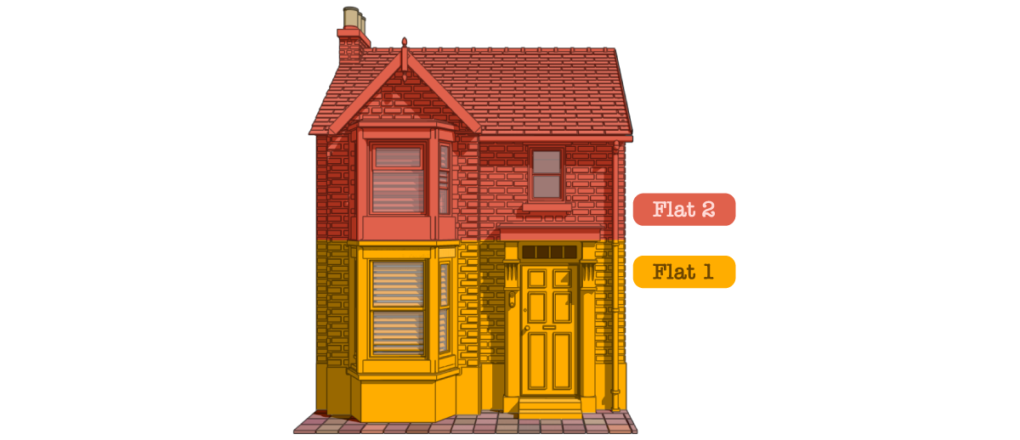
A house divided into two flats can raise questions about who insures what. We explain how ownership, shared structures and occupancy affect the cover you need.
6
min read
A house divided into two flats can look much like any other house from the street. But when it comes to insurance, who owns each flat and how they are used can make an important difference.
You might own the downstairs flat, share the freehold with your upstairs neighbour, or own the whole building and rent out one or both homes. Each situation raises a different question about what needs insuring and who should arrange it.
Start with who owns the flats
Before comparing quotes, establish whether you own one flat, both flats, or a share of the freehold. Also check any lease or title documents setting out insurance responsibilities.
The leasehold arrangements described below relate to England and Wales. Ownership and insurance responsibilities can differ elsewhere in the UK.
You own one flat in the house
If your flat is leasehold, the freeholder will usually arrange buildings insurance for the building, with flat owners contributing towards the cost. Check your lease and ask for details of the existing policy before arranging your own buildings cover.
Some two-flat leases allow the flat owners to arrange insurance themselves. This is why checking the documents matters: having your own front door does not, by itself, tell you who should insure the structure.
If you jointly own the freehold, you will generally need to work together to arrange suitable buildings insurance, taking account of the leases and any management arrangements.
Agree who will organise the cover and how costs will be shared. Make sure the insurer understands the ownership arrangement and whose interests need to be covered.
What if the freehold is owned through a management company?
Sometimes flat owners jointly own the freehold through a management company, rather than holding it in their individual names. In this situation, the buildings insurance policy needs to be arranged in the company’s name.
Intelligent Insurance cannot arrange this cover, as insurance in a company name is treated as commercial insurance and falls outside our home insurance offering. You will need to approach an insurer or broker that can arrange buildings insurance for company-owned freeholds.
You own both flats
If you own the entire property, make that clear when requesting a quote. An enquiry to insure the whole building is different from an enquiry to cover one flat within it.
Explain whether both flats are rented out, both are used by your household, or you live in one and let the other. Ask the insurer or broker which arrangement can cover the building and its actual use.
Do you need one buildings policy or two?
The Association of British Insurers generally recommends insuring flats in the same building together under one buildings policy. This can help avoid complications over shared parts of the property.
However, separate cover may be possible in some circumstances. It needs to be compatible with the ownership documents and acceptable to the insurers involved.
The important question is how the structure is covered. Even if the flats have separate entrances and addresses, they may share a roof, foundations, external walls or other parts of the building.
For example, if a fire damages both flats and the roof, you need to understand how the insurance would respond across the affected parts of the property.
Before choosing separate policies, ask how shared structures are insured, whether there are any gaps or overlaps, and how a claim affecting both flats would be handled. Do not assume that each owner simply needs to insure half the building.
What if you live in one flat and rent out the other?
Tell the insurer about both uses from the outset. Living in the building does not mean an ordinary owner-occupied home policy will automatically cover the flat you rent out.
Explain who owns each flat and whether the letting is to a long-term tenant, paying holiday guests or someone else. If you own only your own flat, make that distinction clear too.
If you are the landlord, discuss whether you also need protection for belongings you provide, landlord liabilities or loss of rent following insured damage. These should not be assumed to be included in buildings cover.
Buildings insurance and contents insurance protect different things. Cover for the structure does not insure the occupants’ personal belongings.
If you live in one of the flats, consider cover for your furniture, clothing and other possessions. If the other flat is rented, the tenant’s belongings are separate from any furnishings the landlord provides.
Even where one policy covers the whole building, the contents arrangements may be different for each flat. Check the policy wording for the treatment of fixtures and fittings as well.
What information should you have ready for a quote?
You do not need to know every insurance term before asking for help. A clear description of the property is a useful starting point. Have the following available where possible:
Ownership details: whether you own one or both flats, and who owns the freehold.
Insurance responsibilities: what the lease or title documents say, plus details of any existing buildings policy.
Occupancy: who lives in each flat, including any letting, holiday use or periods when a flat is empty.
The layout: the number of self-contained flats, their addresses, entrances and any shared areas.
Property details: construction, condition, relevant claims history and any work underway or planned.
Rebuilding information: the relevant rebuilding assessment or sum insured, with clarification of whether it relates to one flat or the whole building.
The rebuilding cost is different from the property’s sale price. If you are unsure what figure to use, ask the insurer or broker what assessment they require rather than guessing or automatically dividing a whole-building figure by two.
What if the house is still being converted?
A completed conversion and a building undergoing work are different insurance situations. If you are dividing a house into flats, speak to your existing insurer before work starts and explain the planned use afterwards.
Ask whether the current policy can accommodate the work or whether specialist house renovation insurance is needed.
Finding cover for your flat
Once you know your insurance responsibilities and what is already covered, you can look for a policy that matches your situation.
If you need buildings insurance for an individual flat and your share of the building, explore our flat insurance page. It explains the circumstances in which Intelligent Insurance may be able to help arrange cover, subject to the insurer’s acceptance and policy terms.
If you need to insure both flats or the entire building, explain that at the start of your enquiry so the provider can establish whether its cover is suitable.
The hot, dry conditions experienced across much of the UK in 2026 have increased concern about subsidence, particularly in areas with shrinkable clay soils.
Destructive tornadoes are rare in the UK, but they can cause serious property damage. Find out how home insurance may respond and what to do after severe wind damage.