Student Contents Insurance: Are University Belongings Covered?
This guide explains how contents insurance can work for students at university, what may be covered and what may need separate cover.
11
min read
This article was updated on the 8th July 2026
Heading off to university often means taking more belongings than expected. Clothes, books, bedding, laptops, phones, headphones, course materials and other everyday items can quickly add up in value.
Before buying a separate student contents insurance policy, it is worth checking whether there is already cover in place. Some students may have belongings covered under a parent or guardian’s home contents insurance while they are away at university, although this will depend on the policy wording, the items being taken, the accommodation, and the limits shown in the policy schedule.
This guide explains how contents insurance can work for students at university, what may be covered, what may need separate cover, and what parents and students should check before relying on an existing policy.
Do students need contents insurance at university?
Students are not legally required to have contents insurance. However, many students take valuable belongings with them to university, and replacing them after theft, fire, flood, escape of water or another insured event could be expensive.
Student belongings may include items such as:
clothing and shoes
bedding and towels
books and study materials
laptops, tablets and phones
headphones and other electronic items
sports equipment
musical instruments
bicycles
Not every item will be covered in the same way. Some belongings may fall within standard contents cover, while others may be excluded, restricted, or only covered if they are specified separately or protected by an optional section of cover.
That is why it is important to check the policy details before assuming everything taken to university is automatically insured.
Can students be covered under their parents’ home insurance?
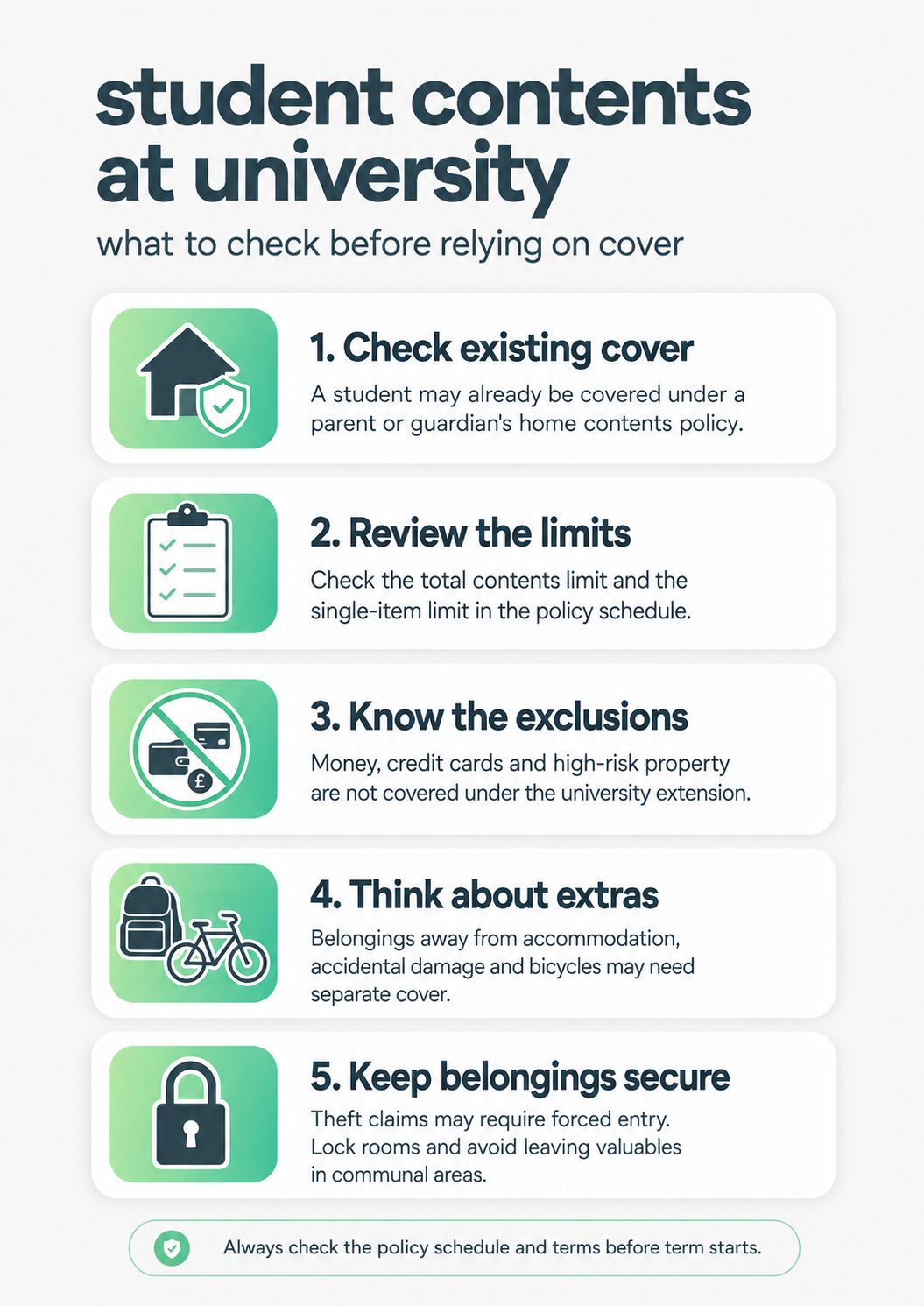
In some cases, yes. A student’s belongings may be covered under a parent or guardian’s home contents insurance while they are away at university.
Under our current home insurance policy, contents belonging to a member of your family in full-time education are covered while they are living and studying anywhere in the United Kingdom. This applies to loss or damage covered by Section 2: Contents, perils 1 to 9, subject to the claim limits, single-item limits, exclusions and conditions shown in your policy schedule.
This can be helpful for parents who already have contents insurance in place and want to check whether their child needs a separate student contents policy.
However, this does not mean every item or every situation is covered. The policy schedule will show the maximum amount payable for any one claim and for any one item, pair or set. It is important to check those limits before your child moves away.
What can be covered while a student is at university?
The Contents at University section can cover belongings against the insured events listed under the main contents section of the policy. These include events such as fire, smoke, theft, attempted theft, storm, flood, escape of water and certain other insured causes, subject to the policy terms.
For a student at university, this may include ordinary contents taken with them, such as clothes, books, bedding and privately owned electronic items.
However, the exact cover depends on the item, the event and the policy schedule. For example, a laptop may need to be considered differently depending on whether it is:
kept inside the student’s accommodation
taken to lectures, the library, a café or while travelling
damaged accidentally rather than by an insured event
worth more than the single-item limit
used for personal study or business purposes
What is not covered automatically?
Student contents cover can be useful, but it is not unlimited. Some belongings and situations may be excluded from the university contents extension or may need to be dealt with separately.
Money and credit cards
Money and credit cards are not covered under the Contents at University extension.
If a student needs protection for money or credit cards away from home, check whether any separate cover applies under the policy schedule. Do not assume these are included as part of standard university contents cover.
High-risk property
High-risk property is also excluded from the Contents at University extension.
High-risk property can include items such as jewellery, watches, precious metals, photographic equipment, binoculars, telescopes, musical instruments, pictures, works of art and collections.
If a student is taking any higher-value or specialist items to university, check whether these need to be specified separately. Items classed as high-risk property may need to be listed individually on the policy, particularly if they exceed the relevant limits or need cover away from the home.
Bicycles are not covered under the standard contents insurance section. If a student is taking a bike to university, check whether optional pedal cycle cover has been added and whether the bike is listed in the policy schedule.
You should also check the security requirements. For example, theft of a pedal cycle from a public place may not be covered unless it is secured by an appropriate lock to a permanent structure or motor vehicle.
Many students carry belongings between their accommodation, lectures, libraries, cafés and public transport.
The Contents at University extension is not the same as general cover for belongings taken anywhere outside the accommodation. If a student regularly takes items away from where they are living, check whether cover away from the accommodation applies.
This may depend on the item, the cover section and the limits shown in the policy schedule. Optional Personal Belongings cover may be relevant for some items, but it should not be assumed to apply to every possession or every situation.
Accidental damage
Accidental damage should not be assumed to be included for belongings at university.
For example, if a student spills a drink on a laptop, drops a tablet or damages an item while moving in, this may not fall under the standard Contents at University extension. The university extension refers to the insured events in Section 2: Contents, perils 1 to 9.
If accidental damage is a concern, check your policy schedule or speak to us before relying on the policy.
Theft without forced and violent entry
Theft is one of the most important areas to check carefully.
Under the Contents at University extension, theft or attempted theft is not covered unless there has been forced and violent entry into or exit out of the building.
This is especially relevant in halls, private student accommodation and shared houses, where several people may have access to the building. Students should take care to lock their room, keep valuables out of sight and avoid leaving belongings unattended in communal areas.
Does cover differ between halls, private accommodation and shared houses?
Yes, the type of accommodation can make a difference.
University halls
Some university halls include a level of contents insurance as part of the accommodation package. This can be useful, but it may only provide limited cover.
It may not include all belongings, high-value items, bicycles, accidental damage or items taken outside the accommodation. Students should check the details of any insurance included with their halls before assuming it is enough.
Private student accommodation
Private student accommodation may also include some level of contents protection, but this varies. Check the tenancy or accommodation agreement and compare it with any cover available under a parent’s home insurance policy.
The student should also check whether the policy covers their own room only, communal areas, bikes, electronics and belongings taken outside the building.
Shared houses
Students living in a private shared house may need to think more carefully about contents insurance. Shared homes can create extra considerations around bedroom locks, communal areas, individual possessions and who is responsible for each item.
If a student needs their own cover for a rented shared property, they may want to consider whether shared house contents insurance is more appropriate.
Should you rely on a parent’s policy or buy separate student contents insurance?
There is no single answer. The right option depends on the student’s belongings, where they live and the level of cover they need.
Using a parent’s contents insurance may be suitable if:
the student is eligible under the policy wording
the student is living and studying in the United Kingdom
the value of their belongings is within the policy limits
the items they are taking are not excluded from the university contents extension
the parent understands that any claim would be made under their home insurance policy
A separate student contents policy may be worth considering if:
the parent’s policy does not provide enough cover
the student has valuable items that need specialist cover
the student is taking a bicycle and no pedal cycle cover is in place
the student needs wider cover for belongings taken outside their accommodation
the student wants cover for accidental damage and it is not provided under the existing policy
the parent does not want a student claim to affect their own home insurance policy
The key point is to check before buying another policy. Some students may already have useful cover in place, while others may need additional protection.
How much contents cover does a student need?
Students often underestimate the value of what they take to university. A few larger items, such as a laptop, phone, bike and headphones, can add up quickly before clothes, books, bedding and everyday items are included.
When working out how much cover may be needed, think about the cost of replacing the items, not what they were worth when first bought.
It can help to group belongings into simple categories:
technology, such as laptops, phones, tablets and headphones
clothing and shoes
books and course materials
bedding, towels and kitchen items
sports, music or hobby equipment
bikes and accessories
jewellery, watches or other higher-value items
You should also check the single-item limit shown in the policy schedule. If one item is worth more than the single-item limit, it may need to be specified separately.
Questions to ask before choosing student contents insurance
Before relying on any cover, ask:
is the student eligible under a parent or guardian’s home contents policy?
are they living and studying in the United Kingdom?
what is the maximum claim limit for Contents at University?
what is the single-item limit?
are any belongings classed as high-risk property?
does the student need to specify any valuable items separately?
is a bicycle being taken, and is pedal cycle cover in place?
are belongings covered outside the accommodation?
is accidental damage included, or excluded?
what theft and security conditions apply?
is any insurance already included with the halls or accommodation provider?
These checks can help avoid buying duplicate cover, but they can also help identify where a separate student contents policy or additional cover may be needed.
Frequently asked questions
Are students automatically covered under their parents’ home insurance?
Not always. Some home insurance policies may provide cover for a child’s belongings while they are away at university, but this depends on the policy wording, limits and exclusions. Intelligent Insurance customers should check their policy schedule or contact us if they are unsure.
Are laptops covered at university?
Laptops may be covered in some circumstances, but this depends on the policy terms, where the laptop is kept, what caused the loss or damage and the limits shown in the policy schedule.
Do not assume a laptop is covered for every situation, especially if it is taken outside the accommodation or damaged accidentally.
Are phones covered at university?
Phones may need cover under a separate section, such as Personal Belongings cover, depending on how and where they are used. If a student regularly takes their phone outside their accommodation, check the policy schedule carefully.
Are belongings covered in communal areas?
Belongings left in communal areas may not be covered in the same way as items kept securely in a student’s room. Students should avoid leaving valuables unattended in shared kitchens, lounges, corridors or other communal spaces.
Are bicycles covered at university?
Bicycles are not covered under the standard contents insurance section. If a student is taking a bike to university, check whether optional pedal cycle cover has been added and whether the security conditions are met.
Does student contents insurance cover accidental damage?
Not always. Accidental damage should not be assumed to be included for belongings at university. Check the policy schedule or speak to us if accidental damage to items such as laptops, tablets or other electronics is a concern.
What happens if a student’s room is burgled?
Theft or attempted theft under the Contents at University extension is only covered where there has been forced and violent entry into or exit out of the building. If a room or external door is left unlocked, this may affect whether a claim is covered.
Will a university contents claim affect the parent’s home insurance?
If the claim is made under a parent’s home insurance policy, it may be treated as a claim on that policy. This could affect future premiums or renewal terms, depending on the insurer.
Final thoughts
Student contents insurance is worth checking before university begins, but it does not always mean buying a separate policy straight away.
A student may already have some protection under a parent or guardian’s home contents insurance, or through insurance included with their accommodation. However, limits, exclusions and optional cover can make a significant difference.
Before relying on any cover, check the policy schedule, the value of the belongings being taken, and whether additional protection is needed for laptops, phones, bikes, valuables, belongings taken outside accommodation or accidental damage.
If you are an Intelligent Insurance customer and you are unsure whether your child’s belongings are covered while they are at university, contact us and we will be happy to help.
What does a specialist home insurance broker do? Learn when their help may be useful and how the broker route compares with comparison sites and buying direct.